Reading Raw Data
Before any reconstruction or analysis, we need to parse k-space raw data into Python objects. However, different users may work with different raw data formats — such as Siemens Twix or ISMRMRD.
Monalisa provides two ready-to-use readers for these formats: - Siemens raw data (Twix format) - ISMRMRD format
If your data is in another format, the simplest solution is to convert it to ISMRMRD.
Basic Usage
Using the data readers is easy. Monalisa provides the create_raw_data_reader function (MATLAB createRawDataReader), which automatically detects the file format and returns the appropriate reader object. The readers need the io extra (pip install -e ".[io]").
import monalisa as ml

f = "/your/path/to/raw_data/rawdata.fileExtension"
autoFlag = False  # False: interactive validation of the metadata; True: no window
# Automatically create the appropriate reader
reader = ml.create_raw_data_reader(f, autoFlag)
It is probable that the parser cannot correctly identify the metadata correctly, since different sequence implementation follow different conventions. That is why we prompt the user with a validation table where it is fundamental to correct any wrong entries:
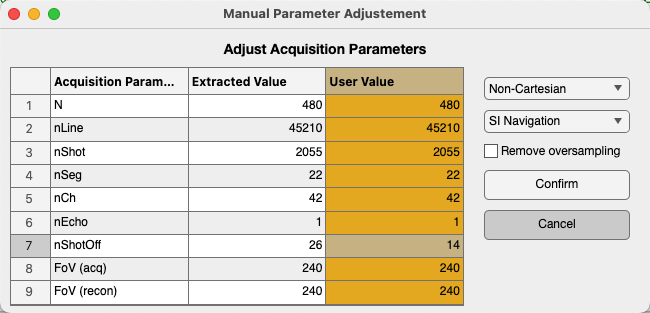
Once the values in the yellow columns are selected, click confirm, to create the reader object. This reader object is passed as input to Monalisa functions, which then use it internally to access raw data and metadata.
With autoFlag = True no window is shown: correct the wrong entries in the code instead, for example reader.acquisitionParams.nShot_off = 14 (any field of reader.acquisitionParams). The screenshot is from MATLAB; the Python window has the same table.
Advanced Details for Developers
Monalisa handles raw data abstraction using the RawDataReader interface class (monalisa.io.RawDataReader, MATLAB mleRawDataReader). This base class defines a standard interface for reading raw MRI data in a vendor-agnostic way.
It defines two main methods:
read_meta_data(MATLABreadMetaData) Parses header information and acquisition parameters from the file, such as: - Number of coils - Acquisition lines - Echo counts - Field of view (FOV) It also analyzes the signal to estimate when steady state is reached.read_raw_data(MATLABreadRawData) Loads and reshapes the actual k-space data into a NumPy array. Typical dimensions include: - Coils - Readout points - Acquisition lines This method can optionally remove unwanted or non–steady-state lines based on flags.
These methods provide a unified interface, abstracting vendor-specific details while ensuring compatibility across the Monalisa pipeline.
Implemented Readers
Monalisa currently includes two subclasses of RawDataReader:
SiemensReaderReads Siemens raw data (Twix.dat) with the twixtools library. Source: https://github.com/MattechLab/monalisa-python/blob/main/src/monalisa/io/_siemens_reader.pyIsmrmrdReaderSupports the ISMRMRD file format (with theismrmrdPython package). Source: https://github.com/MattechLab/monalisa-python/blob/main/src/monalisa/io/_ismrmrd_reader.py
Note on mapVBVD and twixtools
The MATLAB Siemens reader uses the external toolbox mapVBVD, originally developed by Philipp Ehses
(https://github.com/pehses/mapVBVD), in monalisa/third_part/twix_for_monalisa/.
The Python reader uses twixtools, by the same author (https://github.com/pehses/twixtools).
These libraries are not part of the core Monalisa toolbox.
Extending for Other Formats
If you need to support a different file format, you have two options:
Convert your dataset to ISMRMRD (recommended if possible)
Implement a new subclass of
RawDataReaderand override: -read_meta_data-read_raw_data
Source for the base class: https://github.com/MattechLab/monalisa-python/blob/main/src/monalisa/io/_raw_data_reader.py